Why I won’t be visiting Wetherspoons for morning coffee 

While some turn their noses up at JD Wetherspoon, I am a big fan of the budget pub chain. The business has invested considerable sums of money in renovating old pubs over the years – and created many new ones out of interesting disused buildings (like the Prince of Wales in Cardiff that used to be a theatre where, if you get there early enough, you can drink with friends in your own private box).  


I also like the fact you can enjoy a changing range of beers from across the world – supporting independent breweries – at the chain’s outlets. At Wetherspoons there always seems to be an ale festival on and that’s something that should be celebrated. The hot food is getting better as well.


And having conquered the beer market, the pub chain now seems insistent on becoming the UK’s biggest coffee shop. The group already sells around 50 million coffees and 24 million breakfasts a year (the latter being more than that of Caffè Nero or Pret a Manger), but at its latest results Wetherspoons said it wants to triple its coffee and breakfast sales over the next 18 months. 


To entice customers through the door, from Monday it will offer filter coffee (with free re-fills) for 99p or less – as well as deals on breakfasts – to its morning customers in around 880 of its pubs. 
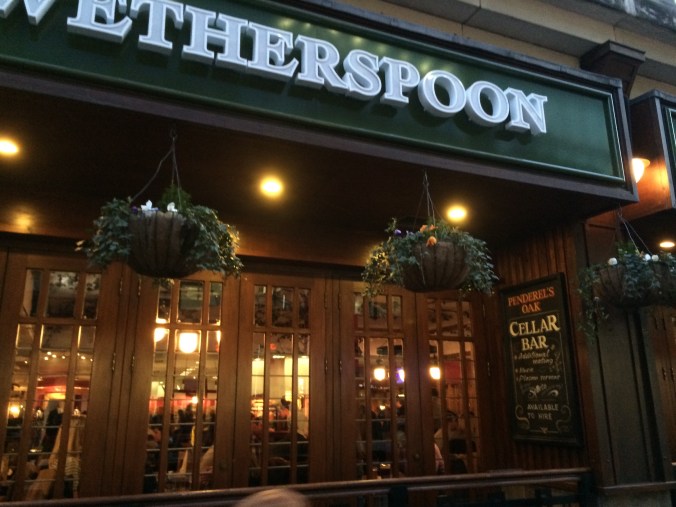


While some may indeed take up this offer, I won’t be one of them. In fact, I can’t think of anything worse than sitting in a dingy pub first thing in the morning, drinking a coffee on my way to work. Great as they are in the evening, I have never been to a Wetherspoons pubs for beers and thought this would be a good place to relax with the newspapers before a busy day.


And then there’s the coffee. Wetherspoons uses a Lavazza coffee but it comes straight from a machine. You don’t get the same experience that is created when a trained barista makes your coffee for you from freshly ground beans. It’s for this reason that I also choose to have a coffee at an independent store – especially those with plenty of natural light – or at a Costa Coffee where I am pretty partial to a flat white made from their special Paradise blend.    


Wetherspoons has my vote for a night out, but I will be drinking coffee elsewhere.   

We shouldn’t fear the machine 

Technology and the impact it can have on jobs is an emotional subject in many industries. New systems can bring cost efficiencies for businesses and noticeable service improvements for customers, but the end result may mean less staff are required to deliver a service (or at the very least they are deployed in different ways).

Unions have understandably been very vocal about this area in recent years. On the London Underground for example, the decision to close the majority of ticket offices in favour of requiring passenger to use self-service machines – or simply use contactless payments – has resulted in a succession of strikes. 

But this week’s Analysis programme on Radio 4 has highlighted that some experts believe technological advances are having a much wider impact than ever before. For a long time machines have put manual workers out of work, but now there is evidence this phenomenon is stretching much further to white collar jobs. 

Central to robots’ ability to muster into so-called ‘cognitive work’ is their ability to recognise ‘patterns’. If programmed correctly, machines now have the potential to perform tasks that were previously conducted by skilled professionals. 

Technological advances are of course nothing new. From the very beginning of the Industrial Revolution – perhaps even earlier – there has been an attempt to bring efficiencies to production processes. 

Rather than smashing up machines like Luddites, I think society should in many ways be optimistic about the impact technology can have on our working lives. As one contributor to this week’s Radio 4 programme pointed out, while robots just follow algorithms humans are very creative beings. So while machines do the drudge work, we can focus on innovating and enjoying much more meaningful things in life.     

For me, as technology advances, education and lifelong learning becomes much more important. While certain roles are being phased out, others – like computer programmers – are struggling to be filled. We need to make sure that our young people are getting the training they deserve to be equipped for the future. 

Desert rainforest shows Dubai has no limits to its imagination

Someone once described Dubai to me as “a Canary Wharf in the sun”; faceless modern tower blocks, surrounded by fake landscaped gardens and man-made beaches. Given the variety of natural beauty spots around the world, why on earth would anyone choose to holiday in this “desert outpost”?

Yet one of my university friends had moved out there and I had promised to visit.

As I set off on my first trip there in 2009, I didn’t have very high expectations. That year many in the media had written off the emirate as it faced up to a collapse of its property market and it was left with £65 billion of debt racked up by state owned companies. Neighbouring Abu Dhabi had to bail it out.

On the plane out to Dubai, I read articles in newspapers about British expats supposedly abandoning their cars at the airport and heading back home because they couldn’t afford the finance. Many had lost thousands from buying properties off-plan and their money vanishing into the sand.

But from the moment my plane landed I was captivated by Dubai. Far from being a place of doom and gloom, people I met there then seemed pretty upbeat. By night, the plush cocktail bars at the top of some of the tallest towers in the world were brimming with activity. By day, people traipsed around expansive shopping malls or enjoyed a quiet coffee down at the marina.

IMG_0206

Of course, Dubai then – as is the case now – was not just a place of leisure and pleasure. Out of sight from visitors, there was of course also some hard graft being committed in their air-conditioned offices. Many major international brands have their Middle Eastern headquarters there.

I have returned to Dubai many times since 2008, including visiting a fantastic music festival on the Palm, the man-made island connected to the main city by a causeway. Often my stay has been as a stop-over to somewhere else like India. And every time I have been there, I have had a good time.

The property market has recovered from those dark days and house prices are now rising to such an extent that some fear that it could crash again.

I am not so sure that the same mistakes will happen again. Dubai today seems much more mature than before. Given what happened in the past, people are more wary about handing over their money to property developers for schemes that may never be built.

But Dubai has however by no means lost its imaginative and creative side. Not satisfied with having indoor ski slopes in mega shopping centres and well-kempt green golf courses crafted out of the desert, plans are now in place to build the first rainforest in the Middle East. The development will be housed in a massive dome – complete with zip lines and walkways – with visitors taken on a journey through the rainforest’s flora and fauna.

And there’s much more planned for Dubai in the run up to the World Expo, which the emirate will host in 2020. Replicas of the Taj Mahal and the Eiffel Tower have been commissioned. The world’s biggest ferris wheel is also being constructed. There are more fun times ahead for Dubai.

If you know me well, you will know that I like – wherever possible – to veer off the tourist trail. But Dubai will always remain high up on my list of favourite destinations. I can’t wait to see what wild and wacky schemes have been built by the time I next visit.